
From lifting a newborn to hours at a keyboard or smartphone, repetitive wrist motion adds up. De Quervain’s Tenosynovitis is a common cause of thumb-sided wrist pain that often goes untreated. Learn what causes it, how it’s diagnosed, and why early care can help prevent chronic discomfort.
How Tendon Constriction Causes Pain and Stiffness
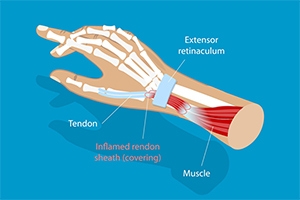
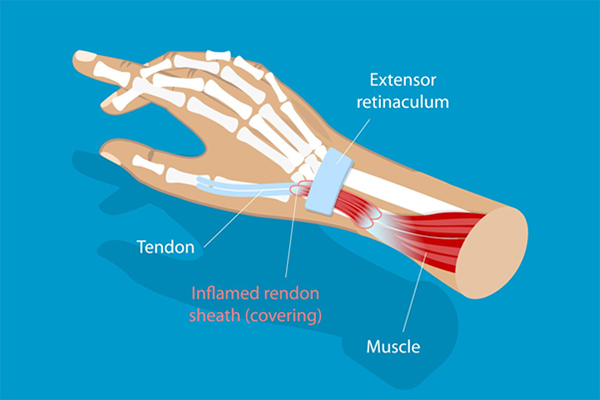
De Quervain’s Tenosynovitis occurs when the tendons around the base of the thumb become constricted. These tendons, specifically the abductor pollicis longus and extensor pollicis brevis, pass through a narrow tunnel, or sheath, on the thumb side of the wrist. When the lining of this sheath becomes swollen, it creates friction, making it difficult and painful for the tendons to slide smoothly.
Key Symptoms That Set De Quervain’s Tenosynovitis Apart
Patients often mistake this condition for general wrist strain, but De Quervain’s has distinct hallmarks. The primary symptom is pain directly over the "radial styloid," which is the bony bump on the thumb side of your wrist. You may also experience:
- Swelling: Physical puffiness near the base of the thumb.
- A "Snapping" Sensation: A feeling that the thumb is catching or "sticking" when moved.
- Increased Pain with Gripping: Difficulty performing tasks that require a forceful pinch or wrist twisting.
A classic diagnostic tool we use is the Finkelstein test. This involves making a fist with your thumb tucked inside your fingers and bending your wrist toward your pinky. If this causes sharp pain, it is a strong indicator of the condition.
Why Repetition Leads to Inflammation
This condition is frequently referred to as "Mother's Thumb" or "Gamer's Thumb" because it is driven by repetitive radial deviation, the side-to-side motion of the wrist. Constant lifting, texting, or even gardening can aggravate the tendon sheath. While overuse is the primary culprit, hormonal changes during pregnancy and rheumatoid arthritis can also increase your susceptibility. Finally, it can occur out of the blue with no identifiable cause.
Effective Treatment and Recovery Pathways
The goal of treatment is to reduce inflammation and give the tendons room to move. In most cases, we begin with non-surgical interventions that yield excellent results:
- Immobilization: Wearing a thumb spica splint for several weeks rests the tendons and prevents further irritation.
- Anti-Inflammatory Medication: Oral NSAIDs can help manage acute swelling.
- Corticosteroid Injections: A targeted injection into the tendon sheath often provides significant, lasting relief by rapidly shrinking the inflamed tissue.
- Occupational Therapy: Learning to adjust your ergonomics can prevent the condition from returning.
If conservative measures fail, a minor surgical release can open the tunnel to provide more space for the tendons, a procedure with a very high success rate and little risk.
Restore Your Wrist Health
Chronic wrist pain should not be a permanent fixture in your life. An upper extremity specialist will focus on accurate diagnostics to ensure you receive the most effective care for your specific lifestyle. If you are struggling with persistent thumb or wrist discomfort, book an appointment at The Hand, Wrist & Elbow Institute for a thorough evaluation and a customized recovery plan.
AUTHOR: John J. Fernandez, MD, is a board-certified orthopedic surgeon specializing in hand, wrist, and elbow surgery. As a team physician having treated professional and collegiate athletes like the Chicago Bulls, Chicago White Sox, and Chicago Steel, Dr. Fernandez has performed thousands of complex procedures involving the wrist in elite athletes.