
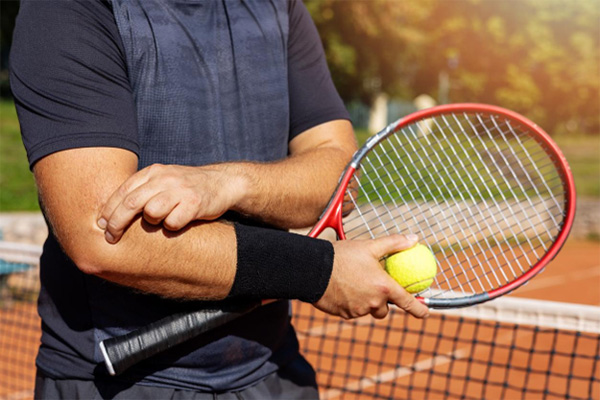
The pain shows up in nearly the same spot, develops the same way, and responds to similar first-line treatment, which is exactly why so many people get the diagnosis wrong on their own. One condition affects the outer elbow. The other affects the inner elbow. Neither requires actually playing the sport in its name. Telling them apart matters, because where the pain originates determines which tendons are involved and how treatment should be approached.
Same Mechanism, Opposite Sides of the Elbow
Tennis elbow, known clinically as lateral epicondylitis, involves the tendons on the outer side of the elbow, which help extend the wrist and fingers. Golfer's elbow, or medial epicondylitis, involves the tendons on the inner side of the elbow that control wrist flexion and forearm rotation. Both conditions develop through the same underlying process: repetitive stress on the tendon at its bony attachment point, leading to microscopic tearing that the body cannot fully repair before the next round of use begins.
Why "Itis" Is Actually a Bit Misleading
Despite the names, neither condition is purely an inflammatory process the way the suffix suggests. Tissue samples from chronically affected tendons typically show disorganized collagen fibers, abnormal blood vessel growth, and degenerative changes rather than the classic markers of inflammation, a pattern often described as tendinosis rather than tendinitis. This distinction matters clinically, because it helps explain why anti-inflammatory medication alone often provides only partial, temporary relief. The tendon is not simply inflamed. It is structurally breaking down and needs an opportunity to remodel and heal.
Telling Golfer’s Elbow and Tennis Elbow Apart Without Guessing
The location of pain is the most reliable initial clue. Tennis elbow typically causes pain on the outer elbow that worsens with gripping, lifting, or extending the wrist, such as shaking hands or lifting a coffee cup with the palm facing down. Golfer's elbow produces pain on the inner elbow that intensifies with wrist flexion or forearm rotation, including swinging a golf club, throwing a ball, or repetitive gripping tasks. It is entirely possible to have both at once, particularly in people whose work or sport loads both sides of the forearm, such as racquet sports, rock climbing, or manual labor involving repetitive hand use. A physical exam that recreates pain with specific resisted movements usually narrows the diagnosis, though imaging such as MRI can help confirm tendon damage or rule out other causes when symptoms are unclear or persistent.
What to Actually Do Once You Know Which One You Have
First-line treatment looks similar for both conditions: relative rest from the aggravating activity, ice during flare-ups, a structured therapy program focused on eccentric strengthening of the affected tendon, and an upper forearm brace to reduce strain during daily tasks. Most cases improve substantially within a few weeks to months of consistent conservative care. However, it may take many months for the process to totally resolve. When symptoms persist well beyond a few months, the conversation shifts towards advanced imaging such as MRI. Surgery remains uncommon and is generally reserved for the small subset of patients whose pain and dysfunction persist despite a thorough trial of nonoperative care. Fortunately, there are now minimally invasive surgical options for these conditions.
When It Is Time to Stop Guessing
Self-diagnosing elbow pain based on which sport you play is unreliable, since most people who develop these conditions never picked up a tennis racquet or a golf club. Pain that does not meaningfully improve after a few weeks of rest and basic home care, or that is accompanied by numbness, tingling, or noticeable weakness, is worth having properly evaluated by an upper extremity specialist.
If elbow pain has been lingering longer than it should, getting an accurate diagnosis is the clearest way to figure out which tendons are actually involved and what treatment will move the needle.
Frequently Asked Questions
1. How do I know if I have tennis elbow or golfer's elbow?
Tennis elbow causes pain on the outer side of the elbow that worsens with gripping or wrist extension, while golfer's elbow causes pain on the inner side of the elbow that worsens with wrist flexion or forearm rotation.
2. Can you get golfer's elbow if you don't play golf?
Yes. Golfer's elbow is commonly caused by repetitive gripping, lifting, throwing, or wrist flexion activities at work, in the gym, or during other sports.
3. Can untreated tennis elbow or golfer's elbow become chronic?
Yes. A small subset of individuals have epicondylitis that does not resolve despite appropriate conservative care. This may be unrelated to whether one continues their activities or sport.
4. How long does it take for golfer's elbow or tennis elbow to heal?
Most cases improve significantly within a few weeks to a few months with consistent rest, physical therapy, and bracing, though more severe or longstanding cases can take longer. However, it is not uncommon for symptoms to persist, even at a low level, for 6-9 months.
5. What treatment options are available if rest and physical therapy do not help?
For the small number of patients who do not improve after a thorough trial of nonoperative treatment, surgery remains an option. Newer minimally invasive arthroscopic techniques, especially for tennis elbow or lateral epicondylitis, allow for a more rapid recovery and a sooner return to activities and sport.
Reference Links:
- Tennis Elbow (Lateral Epicondylitis) - Cleveland Clinic
- Golfer's elbow (Medial epicondylitis) - Mayo Clinic
AUTHOR: Mark Cohen, MD – Orthopedic Hand, Wrist & Elbow Surgeon
Mark Cohen, MD is a board certified, fellowship trained distinguished orthopedic surgeon specializing in hand, wrist, elbow, and upper extremity surgery at Midwest Orthopaedics at Rush, with additional expertise in microvascular and reconstructive procedures. He is based in Chicago and has led the Orthopaedic Hand and Elbow Section at Rush University for more than three decades while also serving as Director of Orthopaedic Education in the department.
Credentials & Recognition
Dr. Cohen earned his undergraduate degree from Stanford University. and his medical degree from Harvard Medical School, graduating Magna Cum Laude. He completed his orthopedic surgery residency at the University of California, followed by an advanced fellowship in hand, upper extremity, and microvascular surgery at the Indiana Hand Center, one of the nation's leading hand surgery training programs.
Dr. Cohen has been recognized numerous times as one of Chicago's "Top Doctors" in Hand and Orthopaedic Surgery by Chicago Magazine including in 2025 and in multiple prior editions since 1997. U.S. News & World Report ranks him among the top 1% of physicians nationwide in his specialty, and he has been named a Castle Connolly Top Doctor — a distinction awarded to less than 7% of physicians across the country. In 2017, he received the Excellence in Clinical Service Award from Rush University for his outstanding contributions to patient care, leadership, and scholarship.
Clinical Expertise
Dr. Cohen’s clinical and research interests focus on fractures and reconstruction of the hand, wrist, and elbow, minimally invasive upper extremity surgery, and complex elbow conditions, including Tommy John surgery for throwing athletes and other sports-related injuries. A prolific academic contributor, he has authored more than 163 peer-reviewed medical articles, 63 book chapters, and a textbook on hand and wrist injuries. He also serves as an editor for Green’s Operative Hand Surgery, the leading textbook in the field.
Dr. Cohen has participated in over 334 continuing medical education courses and has served as Course Chairman 51 times. In addition to his academic leadership, he is a team physician and consultant for the Chicago White Sox and the Chicago Bulls, providing expert care for elite athletes.
Medical Disclaimer: This information is for educational purposes only and does not constitute medical advice. For diagnosis and treatment recommendations, please consult with Dr. Cohen or another qualified orthopedic specialist.
Content authored by Dr. Mark Cohen and verified against official sources.