
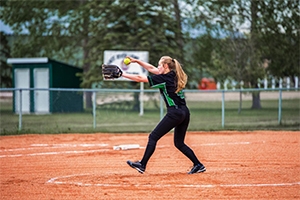
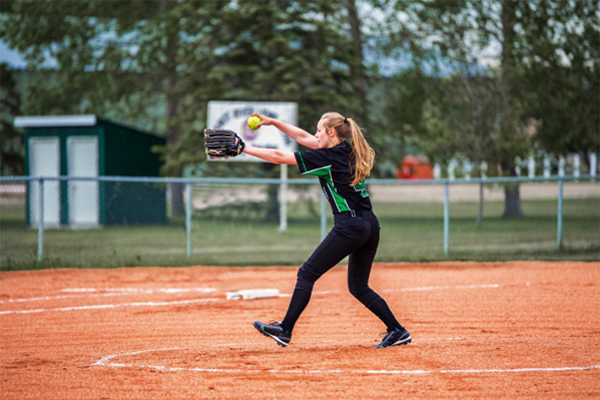
You feel a sharp pain on the inside of your elbow after a pitch, shake it off, and finish the inning. The next morning, gripping a coffee mug hurts and throwing feels impossible. Many recreational softball players assume this inner elbow pain is a simple strain, but it may signal a UCL injury. Learn what is happening inside the elbow and when treatment may require more than rest.
What the UCL Does and Why Softball Players Are at Risk
The ulnar collateral ligament sits along the inner side of the elbow and connects the upper arm bone (humerus) to the ulna. It acts as the elbow’s primary stabilizer during throwing motions.
Each pitch creates valgus stress, a force that pushes the forearm outward while the UCL works to resist that movement. Over time, repeated throwing can overload the ligament.
Recreational softball players may actually be at greater risk than expected. Unlike professional pitchers who train year-round and refine mechanics over years, many adult league athletes throw with inconsistent technique, limited warm-up routines, and reduced conditioning. Summer schedules with multiple games each week add repetitive stress that can gradually wear down the ligament.
UCL Sprain vs. UCL Tear: What Is the Difference?
Not all UCL injuries are the same. They range from mild sprains to complete tears, and treatment depends on severity.
A UCL sprain involves overstretching of ligament fibers without major structural damage. Mild sprains often improve with rest, activity modification, and rehabilitation focused on strengthening the muscles around the shoulder and forearm.
A partial tear means part of the ligament has lost integrity. Some partial tears respond well to non-surgical treatment, while others continue causing pain and instability during throwing.
A complete tear occurs when the ligament fails entirely. The elbow loses stability under throwing stress, often making return to sport difficult without surgery.
Warning Signs of a UCL Tear in Throwing Athletes
The location and timing of pain often provide important clues. UCL injuries such as a UCL tear usually cause tenderness along the inner elbow, specifically near the medial epicondyle. Pain often becomes sharp during throwing, especially during arm acceleration.
Other warning signs include:
- Pain that returns every time you throw
- A feeling of looseness or instability in the elbow
- Reduced throwing velocity or control
- Swelling along the inner elbow
- Numbness or tingling in the ring and little fingers due to nearby ulnar nerve irritation
Muscle soreness tends to improve after several days of rest. Persistent pain tied specifically to throwing deserves evaluation.
From Rehabilitation to Tommy John Surgery: UCL Care Explained
Diagnosis begins with a physical examination and specific stress tests to assess elbow stability.
Imaging may also be recommended. MRI, particularly MRI arthrogram studies, can help identify partial tears, complete ruptures, and related injuries involving cartilage, tendons, or the ulnar nerve.
For many recreational athletes, treatment starts conservatively.
Non-surgical management may include:
- Temporary rest from throwing
- Strengthening exercises for the forearm and shoulder stabilizers
- Physical therapy
- Gradual return-to-throwing programs
- Activity modification during recovery
Many recreational players with mild injuries return successfully without surgery.
When symptoms persist despite rehabilitation or imaging confirms a complete tear, UCL reconstruction may become necessary.
Often called Tommy John surgery, this procedure replaces the damaged ligament with a tendon graft, usually taken from the forearm or hamstring. The new graft restores elbow stability and supports return to throwing activities.
Frequently Asked Questions About UCL Injuries
Can a UCL tear heal without surgery?
Partial tears sometimes improve with rehabilitation and activity modification. Complete tears generally do not heal sufficiently for athletes hoping to return to throwing sports.
How long is recovery after Tommy John surgery?
Most recreational athletes need approximately 9–12 months before returning to competitive throwing.
Is Tommy John surgery only for professional players?
No. Recreational softball players, tennis athletes, and other overhead athletes may also require UCL reconstruction depending on injury severity and goals.
Can UCL injuries be prevented?
Proper warm-up routines, strengthening programs, limiting excessive throwing volume, and addressing pain early can reduce risk.
Address UCL Symptoms Before They Become Season-Ending Injuries
Elbow pain during summer softball leagues is easy to dismiss, especially when the season is in full swing. But UCL injuries deserve more attention than a week of rest. Early evaluation and proper treatment can make the difference between missing a few games and losing an entire season. Recognizing symptoms early gives recreational players the best chance of returning safely to the field.
Reference Links:
- Ulnar Collateral Ligament (UCL) Injuries of the Elbow - Johns Hopkins Medicine
- Ulnar Collateral Ligament (UCL) Injury - OrthoInfo from the American Academy of Orthopaedic Surgeons
AUTHOR: Xavier Simcock, MD – Board-Certified Orthopedic Hand, Wrist & Elbow Surgeon
Dr. Xavier Simcock is a board-certified orthopedic surgeon specializing in surgery of the hand, wrist, and elbow. He practices at Midwest Orthopaedics at Rush and is dedicated to advancing upper extremity care through precision surgery, innovation, and patient-centered treatment.
Credentials & Recognition
Dr. Simcock was born in Auckland, New Zealand, and raised in Denver, Colorado. He graduated Summa Cum Laude from Washington University in St. Louis, where he received Sigma Xi research honors in biology. He earned his medical degree from Columbia University Vagelos College of Physicians and Surgeons, graduating Alpha Omega Alpha (AOA) and receiving the New York Orthopedic Hospital Award. His early orthopedic research was supported by grants from the NIH and the Arthritis Foundation.
He completed the prestigious Harvard Combined Orthopedic Residency Program, where he was honored with the Resident Excellence Award for Teaching and Mentorship and the William H. Thomas Award for excellence in orthopedics. He was also selected by the Alpha Omega Alpha Honor Medical Society as an Emerging Leader.
Dr. Simcock further refined his expertise through two advanced fellowships sponsored by the American Society for Surgery of the Hand (ASSH): one in hand and microsurgery and another in shoulder surgery at the Cleveland Clinic.
Clinical Expertise
Dr. Simcock specializes in complex conditions of the hand, wrist, and elbow, including fracture fixation, tendon and ligament reconstruction, nerve conditions, arthritis management, and microsurgical techniques. He is highly experienced in both traditional and minimally invasive surgical approaches to restore motion, relieve pain, and improve upper extremity function.
His academic contributions include authoring book chapters on upper extremity fracture fixation and reconstruction, as well as publishing numerous peer-reviewed scientific articles focused on conditions affecting both adults and adolescents. He has been featured in clinical teaching videos for the New England Journal of Medicine and the American Society for Surgery of the Hand, reflecting his commitment to surgical education and innovation.
After a successful period in private practice in Boston, Dr. Simcock joined Midwest Orthopaedics at Rush, where he continues to provide expert, evidence-based orthopedic care and remains dedicated to improving patient outcomes through advanced surgical techniques and research-driven practice.
Medical Disclaimer: This information is for educational purposes only and does not constitute medical advice. For diagnosis and treatment recommendations, please consult with Dr. Simcock or another qualified orthopedic specialist.